What is scoring
A ‘performance score’ is generated for every supplier for every parameter in Responsibly. The purpose of the score is to distill all the information on the supplier into a comparable score that shows how that supplier is performing relative to its peers The score is evaluated on 4 levels:- Data entry score: Every data entry is mapped to the parameters it provides information on, and is scored according to the effect it has on that parameter
- Parameter score: Performance on individual parameters like e.g. ‘child labor’ or ‘deforestation’ are scored based on the data points on that parameter + supplier
- Scorecard score: The user can create scorecards with combinations of parameters to produce a score for a group of parameters within e.g. ‘human rights’ or ‘circularity’. These are fully customizable and can be weighted
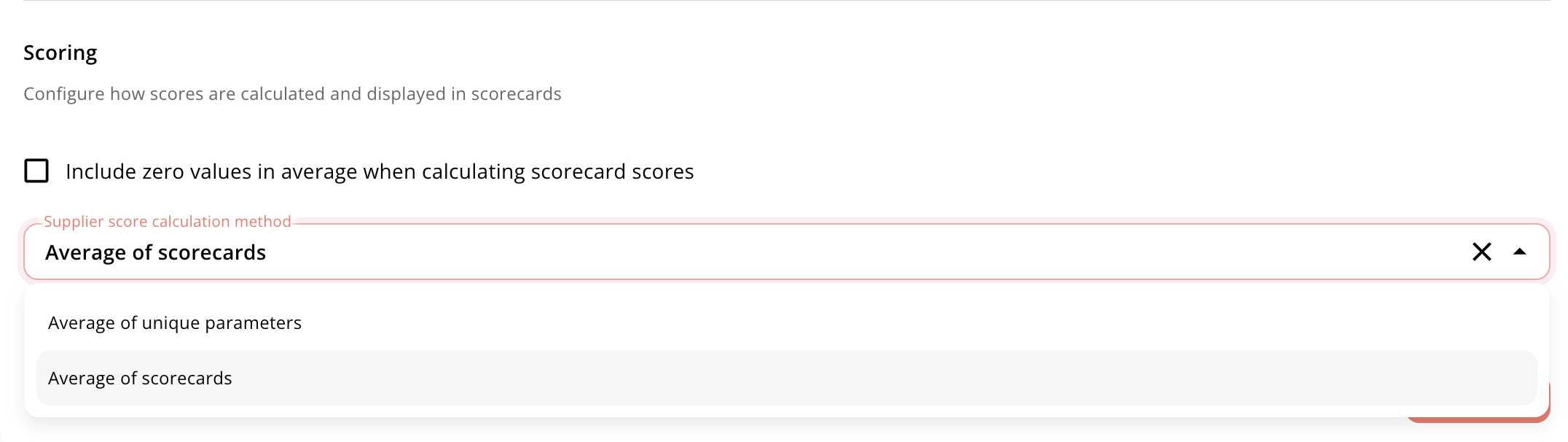
- Supplier overall score: Finally, the overall supplier score is calculated based on the scorecards evaluated for that specific supplier. The supplier overall score can be calculated by either averaging the unique parameters across the scorecards, or by averaging the scorecards
The Responsibly scoring scale
Responsibly’s scoring framework is on an absolute scale not a relative scale like e.g. a benchmark. That is intentional to ensure ‘good performance’ is not just given because of a poor performing peer group. The Responsibly scoring scale ranges from -3 to +3| Performance score | Definition | Example |
|---|---|---|
| -3: Very poor | The company has committed recent and confirmed violations in the form of lawsuits or penalties. The company has also shown no commitment to the topic. | A confirmed lawsuit on child labor within 5 years → parameter: ‘child labor’ |
| -2: Poor | The company has allegations for violations committed, or older confirmed violations. Again, no commitment is shown to address the topic. | An allegation of a corruption case, but the case has not been settled in a court. → parameter: ‘corruption’ |
| -1: At risk | The company is materially at risk for the topic through older violations and/or medium/high inherent risk. No recent events have been identified, and no positive actions has been identified either. | A factory located in a very high risk area for forced labor like Xinjiang, China. → parameter: ‘forced labor’ |
| 0: Inaction | The company is not materially at risk for the topic, as no violations or inherent risk has been identified. No positive actions have been identified. We recommend to not include “zeroes” in the supplier overall score for immaterial parameters. | No information, or only expired information like an old out-of-date certificate. |
| +1: Okay | The company has committed to improving or managing the topic and has put policies and/or procedures in place. There are indications of intent, but no verified evidence of positive performance. | An environmental policy. → parameters: multiple (e.g. Deforestation, Biodiversity, etc.) |
| +2: Good | The company is meeting most requirements for addressing risks in the topic area. Good governance is demonstrated through certifications or audits. Targets for future improvement may be defined. | An ISO 45001 certificate for occupational health and safety → parameter: Health and safety |
| +3: Very good | The company is a demonstrable top performer and has received top results from strong audit or certification standards verified by a third party. | An 1.5 degree and Net Zero SBTi target → parameter: Emission reduction targets |
What affects scoring?
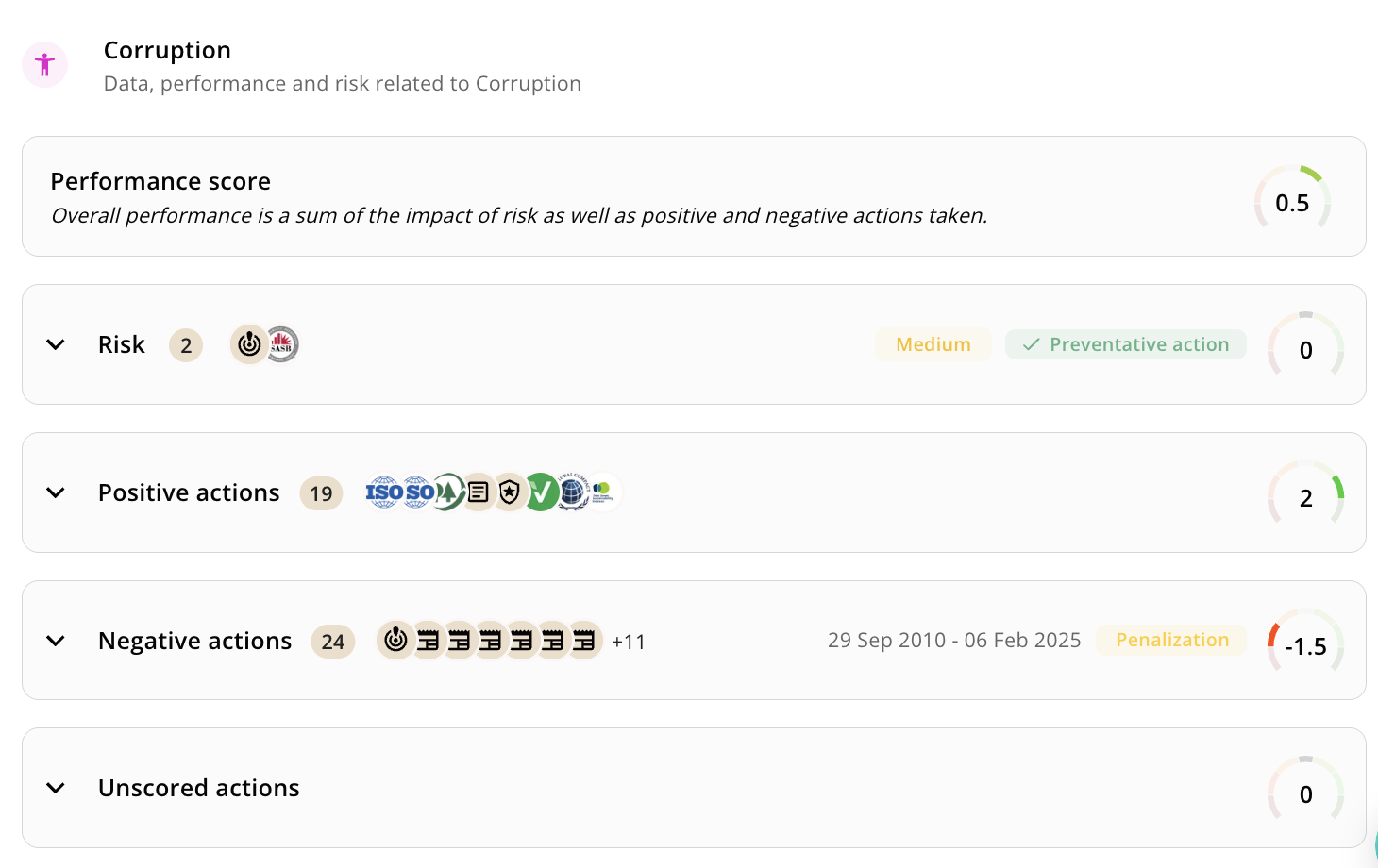
Examples of what effects scoring are already given in the table above. The score of every parameter can be navigated by clicking the parameter in question. The parameter is scored based on:- Inherent risk: i.e. is the company operating in an inherently risky context based on its industry and location(s) and the intersection of these
- Positive actions: i.e. what positive actions is the company taking to mitigate said risk, or to in general, demonstrate positive actions towards the topic
- Negative actions: i.e. has the company been involved in negative action. How old are those events, and has it been confirmed or is it an allegation
- Unscored actions are shown but does not affect scoring
Possible scoring scenarios
Beyond the clear scenarios where only positive or negative actions are identified, more complex scenarios often surfaced, and the impact on the final score is demonstrated below:| Scenario | Commentary | Effect on final score |
|---|---|---|
| Strong negative (-3) signals identified while positive actions are also in place | Supplier is penalized by -1.5 points. If the incidents that penalizes the score are managed through corrective action, the score jumps back up to the original score | Strong positive actions + strong negative: +3 - 1.5 = 1.5 Medium positive actions + strong negative: +2 - 1.5 = 0.5 Weak positive actions + strong negative: +1 - 1.5 = -0.5 |
| Medium negative (-2) signals identified while positive actions are also in place | Supplier is penalized by -0.5 points. If the incidents that penalizes the score are managed through corrective action, the score jumps back up to the original score | Strong positive actions + medium negative: +3 - 0.5 = 2.5 Medium positive actions + medium negative: +2 - 0.5 = 1.5 Weak positive actions + medium negative: +1 - 0.5 = 0.5 |
| Weak negative signals (-1) identified while positive actions are in place | Since weak negative signals infers risk, the positive action is deemed to manage that risk, hence no penalization is applied | Strong positive actions + weak negative: +3 - 0 = 3 Medium positive actions + weak negative: +2 - 0 = 2 Weak positive actions + weak negative: +1 - 0.5 = 1 |
What topics does a supplier get evaluated on?
As mentioned under ‘what is scoring’, Scorecards is ultimately how you decide which parameter a supplier should be evaluated on Read more about how to set-up Scorecards in the scorecards section Responsibly has templates for how scorecards can be set up that maps to leading frameworks and regulations like the OECD or CSDDD but ultimately this is customizableShould a supplier get evaluated on an immaterial topic?
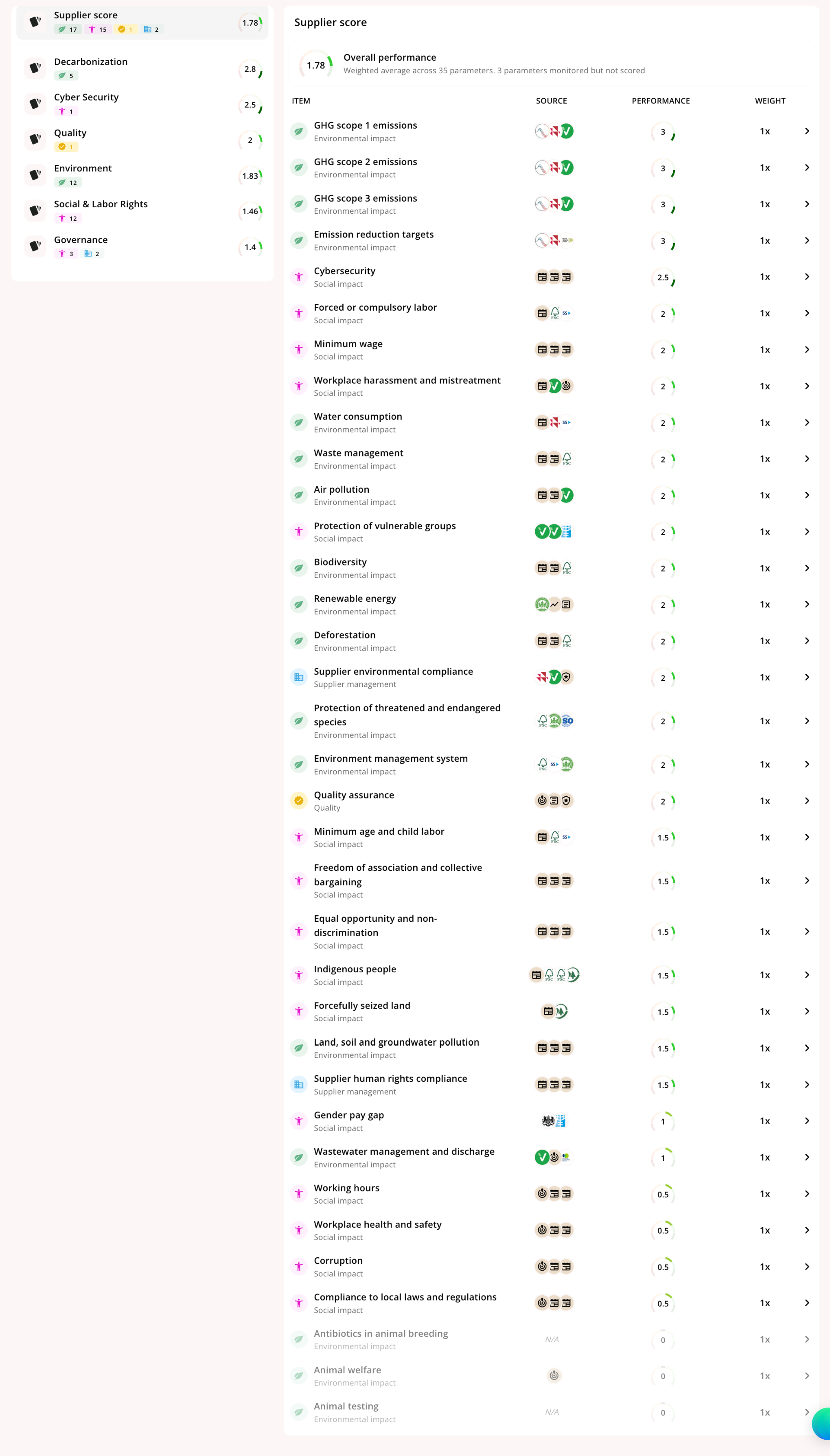
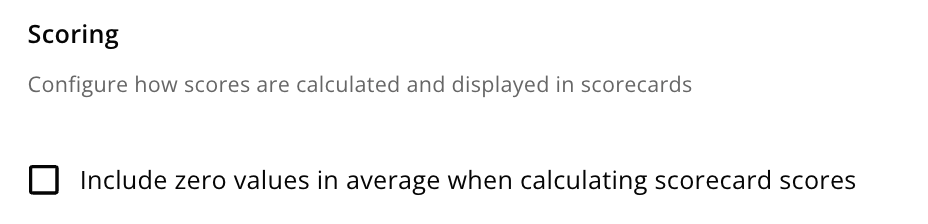
Since you can setup scorecards for different countries and categories, you can theoretically tailor scorecards just to address the material topics for any given supplier, however, in practice, the amount of variations you would need to create gets impractical Instead, the default in Responsibly is that we only score material topics, highlighted simply by the fact that any material topic either has risks, positive, or negative actions attached. If it’s not inherently risky, not positive or negative actions are present, then the topic is immaterial, and not evaluated In practice, this means that parameters scored ‘0’ are not counted in the average and therefore does not pollute the overall score of the supplier because you’re evaluating the supplier on topics not relevant to said supplier, like the 3 social topics for a Danish software supplier in the screenshot below: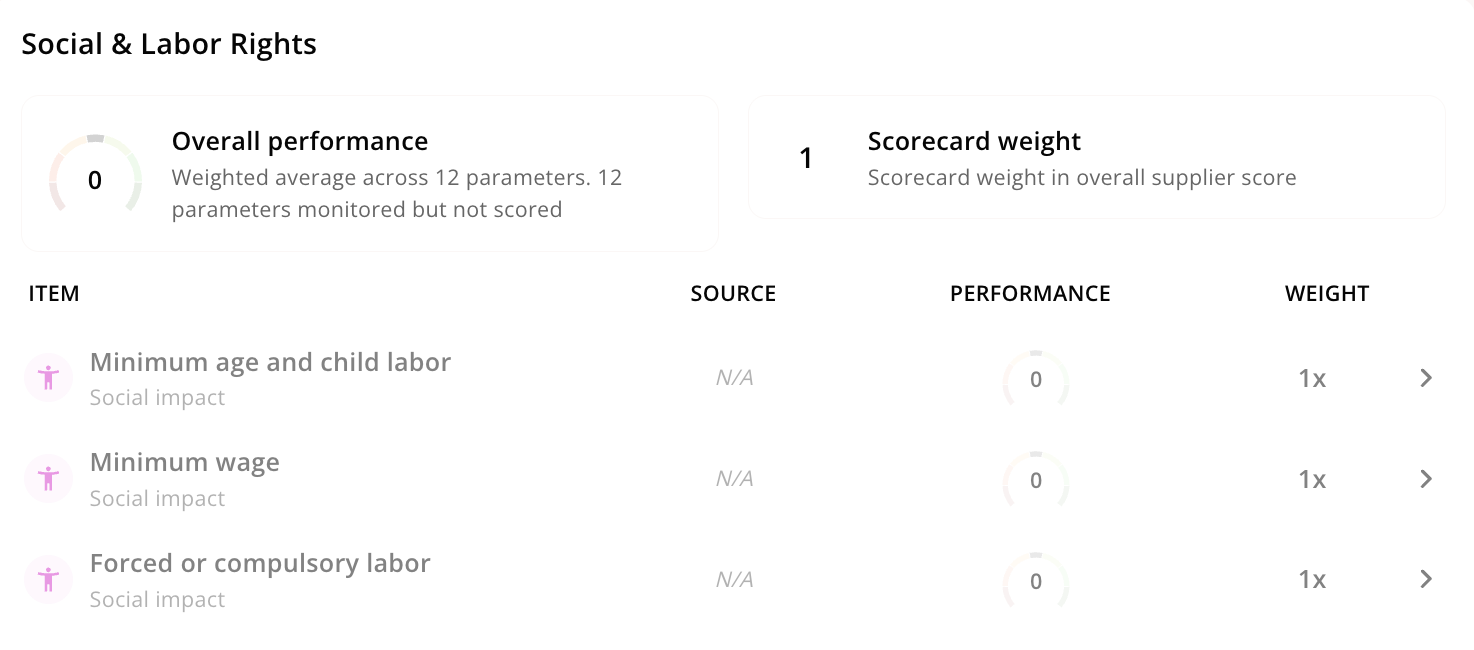
Weights in scoring
As a default all topics are weighted equally in both scorecards and the overall score However, that may not always be appropriate for your setup, as some parameters like ‘forced labor’ may need a higher weight assigned versus others To permit this, we allow users to customize the weights between parameters and their effect on a scorecard, and the weights between scorecards and their effect on the supplier score To learn more about weights go to Scoring weights sectionSupplier overall score
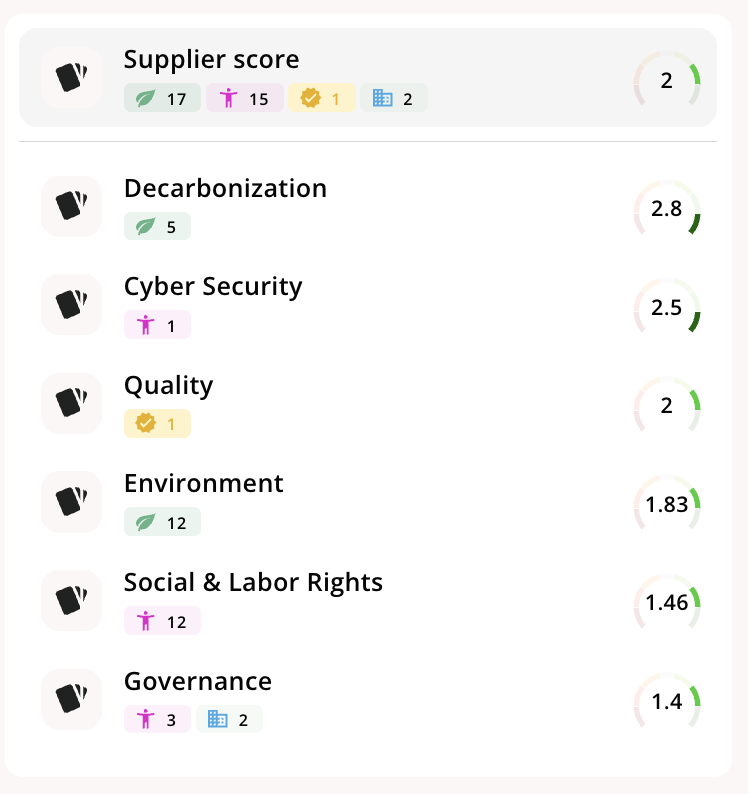
As mentioned at the start of this page, the scoring ultimately summarises into an overall score for the supplier It’s important to understand that the more topics you’re evaluating a supplier on, the more ‘grey’ the overall score can become assuming all parameters are weighted equally. This is to be expected, as deviances in one area may be made up by top performance in other areas. Therefore, ensure you’ve adjusted weights to indicate your priorities The default setting is that the supplier’s overall score is a simple (or weighted) average of the scorecards available on that supplier. E.g. in the example below, the supplier is evaluated on 6 scorecards with varying performance and equal weights